Showing posts with label Research book 7. Show all posts

Tuesday, 1 December 2015

Jan Saudek - WB 2,7

Jan Saudek is a photographer born in Prague his mostly known for his nude sexual imagery. But what is fascinating about these particular is the fact that he takes these images with a pinhole camera and then colours the print. The detail in his images are outstanding and to colour every inch of the image to give it its own uniqueness is something quite remarkable. He bases his images around the relationships between man and woman and parent and child. But you mainly see sexual relationships throughout his images with some them bordering on pornography with the erotic poses and positions. He also brings into his images beautiful and perfect crossed with old and decay, in most of his images there's the crumbling wall behind the subjects which appears in most of his images. The images may shock a lot of observers because of the extremely fleshy, erotic sexual scenes in the images. I like the style in which Saudek produces these images I don't particularly like some of the subject poses in particular images, but the process and lengths he goes to to create these pieces of work is mind blowing. The colours he uses for the subjects are vibrant and eye catching where as the background  are washed out dull colours this is so the subject and message shout louder to you and immerse you into the meaning behind his work.


Zeb Andrews - Modern day pinhole photographer.

http://zebandrewsphotography.com/
20.12.15


poplars

Poplar farm along I-84 in Oregon, 30 seconds
Those of you who know me, know that I enjoy my pinhole camera.  I rarely go out on any photographic excursion without it in fact.  So, I figured I would spend a few minutes tonight introducing it to those of you who are not familiar with it.
The camera I use is made by in Hong Kong.  They make beautiful, wooden cameras that operate as wonderfully as they are beautiful.  My specific camera is the Zero 6×9 multi-format, though I only ever shoot it in 6×9.
There are three main reasons I enjoy my pinhole so much: it is slow, it is simple and it is durable.  I am often amused at the irony that my love of nature and my love of photography have combined to get me out to more places than I would have otherwise, but that pressing desire to photograph those places sometimes causes me to rush and scramble so much for the next shot as to actually distract me from enjoying the scenery right in front of me.  The aperture on my pinhole is a “blazing” f250.  That means even on fairly bright days I am going to have exposures ranging from 15 to 60 seconds in length.  It is not uncommon for me to expect to wait out a five or eight minute exposure either.  What I have found this does is that it slows me down.  I tend to find myself relaxing a bit more, looking around, studying and planning, but also just simply enjoying.  The required wait on the camera pays off in a more relaxed approach to the landscape around me.
Salmon Street Springs, 8 seconds

Salmon Street Springs, 8 seconds
Finally, I can rarely have a discussion about pinhole without mentioning how durable this camera is.  My camera has been dropped into the ocean…twice.  It fell off my tripod and got swept over the Eagle Falls at Lake Tahoe.  It jumped off my lap and out of a parked car in NW Portland once, shattering itself on the sidewalk.  It was probably tired of being dropped in the ocean.  But for all those adventures, it still works.  The images it makes look as good as the day I bought it.  The second time it fell in the ocean, it took about three minutes for me to find it in the surf.  When I did, it was buried under wet sand, with only the leg of my tripod to indicate where it was.  I opened the camera, dumped out the salt water and sand, then ran it under the faucet in a nearby restroom to rinse it out.  I dried it with paper towels and had it reloaded within 15 minutes.  I cannot say this would have been possible with any of my other cameras.  As long as I can keep the box light tight, and as long as I do not damage the pinhole itself, this camera will last a lifetime or more.
Of course, it does not look nowhere near as nice as it used to.  But it has plenty of character, and stories.


Pinhole Photographer - Noriko Ohba


I was born in Hiroshima, Japan and now am living in Osaka with my husband.
I think I found a way to express myself by starting taking photos.
Since I met a pinhole photos, my life is getting fun and interesting.
I'm very courious person and once I start doing something interesting I always spend a lot of time and focus on it.

The light through a pinhole which is printed on a film expresses a temperature, humidity, scent, people's talking, my mind, thoughts and wishes...
It is a wonderful (amazing) expression that everything is coming together in one photograph.
This is why I love a pinhole photograph so much.

Noriko Ohba


http://www.tea-room.net/profolio/index.php#
20.12.15

Monday, 2 November 2015

Advanced Pinhole Camera - WB 2,7

Making a Pin Hole Camera With A Lens:

I am looking at creating an advanced pinhole camera which includes a lens added on to the box. I'll be using a magnifying glass as my lens, with a piece of metal which will have a precision cut pin hole. This will be where the light enters to travel through the box to hit the light sensitive paper. The cut will be a 2mm hole this is easier number to work with in working out the calculations for the f stop number so for example 240mm divided by 2mm (hole size) = aperture of F120. Another important area to get right before making the box is to figure out the focal length with the magnifying glass this will determine what size box you are going to need. As there needs to be enough depth for the image to be in focus what ever that works out to be. My magnifying as a focal length of 24 so I need to ensure my box is long at least that deep in order for me to produce a focused image. 
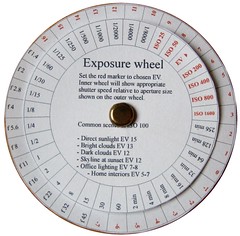
To work out the exposure values I'm going to make an exposure wheel which will then give me all the information I need once I know my f number and focal length. 


https://www.google.co.uk/search?q=pinhole+camera+exposure+value&espv=2&biw=1040&bih=758&source=lnms&tbm=isch&sa=X&ved=0CAgQ_AUoAmoVChMIxK2DrM_xyAIVhi4aCh0Q7wr_#imgrc=aXdvyhFfpDWy1M%3A

Materials needed for making your camera:

Box (Depends on my lens focal point to determine the size)
Black gaffer tape
Thin piece of metal with a pinhole cut out (2mm hole)
Scissors
Screw lidded top to cover the pinhole
Black paint
Magnifying glass
Super glue
Paint brush
Drill piece

Making my camera:

On constructing my camera I first used black gaffa tape to light proof the outside of the box and the lid. I then used black matt paint to paint the inside of the box. On the lid of the box I cut out a square hole this is where the aluminium plate will sit with the 2mm hole drilled out. With the plate stuck down and taped round (not taping over the hole) I super glued the magnifying glass down over the plate to create the lens. After that set I then glued and fixed down the screw lid this will act as my shutter, I made sure to gaffa tape the lid and screw part to make sure no light leaks through. I then fixed inside the box a black cardboard sheet which curves round with it curving will add some nice depths to the images once I start taking photos.  


My finished advanced pinhole camera.


Basic Pin Hole Cameras - WB 2,7

How to create a basic pin hole camera

To create a basic pin hole camera is easy you can use pretty anything which acts as a chamber to capture the image. The object needs to be light proof and which isn't reflective inside. Easiest thing to use is a box, you need to cut a hole in one side of the box and with a tin or aluminum piece of metal pierce it with pin this will act as your aperture to allow the light to pass in. You will need to get either black tape or a piece of blue tak to cover the hole before your ready to expose and after you have exposed. In the opposite side of the chamber you will need to gain access to load some light sensitive paper remember this will have to be done in the dark with no light source around as this would effect the light sensitive paper and it would be no good. AS long as you make sure your box is completely light poof with either black tape and black matt paint you are ready to go and experiment with your box pin hole camera. You can experiment with different exposure times and so forth to create different images with different effects.

Examples of basic cameras:

 
janneinosaka.blogspot.com


hweeling.blogspot.com


petapixel.com


Examples of pinhole images:

Image result for pinhole
https://benpartridge.wordpress.com/portfolio/photography/pinhole-photography/


news.open2view.com


www.pinholephotography.org

Getting to know Dad

http://www.bbc.co.uk/news/in-pictures-22150973
2.11.2015

Heres a video showing how you can make a 6 month long exposure camera using a beer can!


https://www.youtube.com/watch?v=wtZOWEB_wcI&feature=youtu.be


Thursday, 22 October 2015

APPLIED PHOTOGRAPHIC TECHNIQUE - WB 2,7

HISTORY OF PINHOLE PHOTOGRAPHY

The first image made using light sensitive paper and taken by a pinhole camera was in 1850 and over the last 160 years, schools of artists and photographers have become pioneers in this medium, showing us that a camera isn’t always necessary to make a photographic image. From Man Ray to Cordier, cameraless images honour modernism and the Bauhaus. They embody surrealism and the Avant Garde. More recently, through artists such as Fabian Miller, they are traditional, philosophical, and embody the rurality of the countryside.
In the 21st century, the age of the ‘snapshot’, it is interesting to find artists who continue to strip the elements of photography down to its purest forms, casting shadows on to light sensitive paper.


A pinhole camera also known as a camera obscura, is a simple optical imaging device usually made with a box. In one side of the box is a small hole where light passes through to create an image inside the box. The box inside needs to be completely black as well as the outside of the box which needs to be completely light proof. Up to a certain point the smaller the hole the sharper the image, a 2mm hole is what is most commonly used.

Principle of a pinhole camera light rays from an object pass through a small hole to form an inverted image. Because light travels in straight lines this is why the image shows upside down and not the right way up.


Principle of a pinhole camera: light rays from an object pass through a small hole to form an inverted image.